If you have not registered for this on-demand webinar yet, please register below. Once you register, we will send you an email with a password to immediately access the content. The password can be reused to view the content anytime and to be used to view any of our our on-demand videos.
As hardware designs grow more complex, architectural exploration is increasingly critical to delivering differentiated silicon. Teams frequently develop promising architectures only to discover late in the cycle that physical implementation is too costly or fails to meet key specifications. This challenge intensifies as designers integrate new accelerators — video, audio, ML, or custom datapaths — rapidly expanding the search space.
AI-based automation can help, but only when each exploration trial provides cost metrics (area, timing, power) that are both fast and credible. Traditional parameter sweeps are slow. Full physical analysis is expensive. And without correlation to real implementation costs, AI-guided exploration can simply produce the wrong answers faster.
Rise Design Automation and Precision Innovations are partnering to change this dynamic. Together, they deliver fast, accurate, physically aware exploration loops — ideal for reinforcement learning, iterative refinement, and high-volume experimentation.
Rise Design Automation provides 10× faster High-Level Synthesis (HLS) with timing and area correlation within a few percent of downstream RTL-synthesis results. The Rise toolchain can also execute downstream tools “under the hood” and incorporate their feedback directly into HLS. Integrating Precision Innovations’ industry ready OpenROAD-based RTL→GDSII flow and OpenROAD Flow Scripts adds production-grade physical estimation with strong area and timing accuracy validated down to advanced nodes (including 2–3nm).
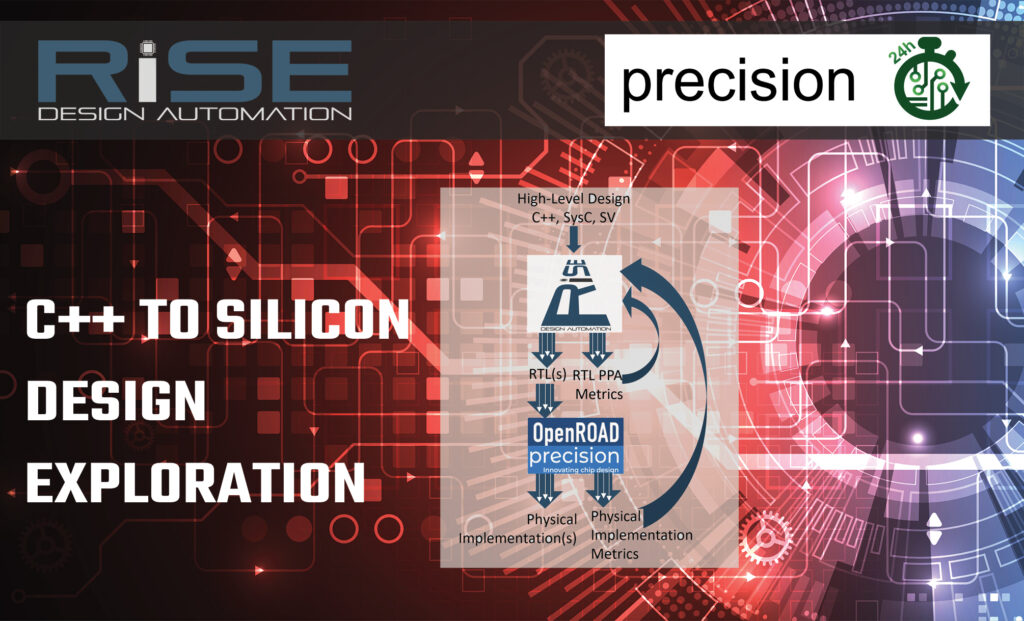
Combined, this integrated flow enables rapid exploration from high-level C++/SystemC/SystemVerilog through synthesized RTL to physically correlated PPA — supporting hundreds or thousands of trials without licensing barriers.
This session demonstrates how an integrated, AI-driven architectural exploration solution from Rise Design Automation and Precision Innovations provides rapid, actionable feedback to guide design decisions, and how you benefit from these capabilities in your own design flow.
In this technical deep dive, you’ll see how Rise Design Automation and Precision Innovations help you:
This webinar highlights practical techniques to accelerate exploration, increase confidence, and improve architectural decisions earlier in the design process.
See a complete exploration loop from high-level behavioral model through Rise Design Automation’s HLS, through RTL synthesis, and into Precision Innovations’ OpenROAD-based physical estimator — with AI-guided refinement driven by real PPA feedback
Hardware architects, design engineers, verification leads, and research teams who want to:
Whether you’re adding a new accelerator to an SoC or exploring ML-driven design automation, this session provides a practical foundation for leveraging Rise + Precision.
 Tom Spyrou is the CEO of Precision Innovation Inc, the primary industrial developer of the OpenROAD EDA tool suite. Tom is a well-known EDA system architect. Before his current position, Tom has worked for over 30 years as an EDA Technologist and has gained extensive experience in areas including Static Timing Analysis, Logic Synthesis, Power Grid Analysis, Database Technology and Floor-planning. He has led the development of leading-edge commercial engines and products such as PrimeTime, Voltage Storm, First Encounter, and the Open Access Database. He was a key architect of timing closure in the Altera Quartus FPGA design tool. Tom has been driving EDA algorithms to utilize parallel programming approaches with both multi-process and multi-threaded techniques. He has a BS from Carnegie Mellon University in ECE and an MS from Santa Clara University.
 Mike Fingeroff, Chief of High-Level Synthesis (HLS) With over 20 years of experience in hardware design automation, Mike has specialized in High-Level Synthesis (HLS), focusing on machine learning and early performance modeling using SystemVerilog, SystemC, and MatchLib. He is the author of The High-Level Synthesis Blue Book, and his expertise includes C++, SystemC, and video and wireless algorithms.
 Allan Klinck, Co-Founder Allan is a co-founder of RDA and a technology leader with expertise in high-level design and AI/ML frameworks for verification. He has driven innovation in verification and low-power technologies, helping teams enhance efficiency and performance in modern, complex designs.